
The Hidden Cost of Overtime Mistakes: How Small Payroll Errors Drain Big Money
Most overtime errors don’t look like mistakes—they look like small rounding differences. But over time, they quietly cost businesses lakhs. Here’s where payroll goes wrong and how to fix it.Discover the most common errors, their financial impact, and how to fix overtime calculations accurately.

If you manage a shift-based team, overtime isn’t an exception - it’s routine. And if your payroll still depends on spreadsheets, CSV exports, or manual calculations, there’s a quiet truth you should know:
Your overtime is probably wrong. Not disastrously wrong, just consistently wrong.
A few hundred rupees lost here. A few extra hours paid there. Numbers that look close enough to pass. Until one day, it became large enough that over a year it sums up to huge real money and severe risk.
The four overtime mistakes that happen most often:
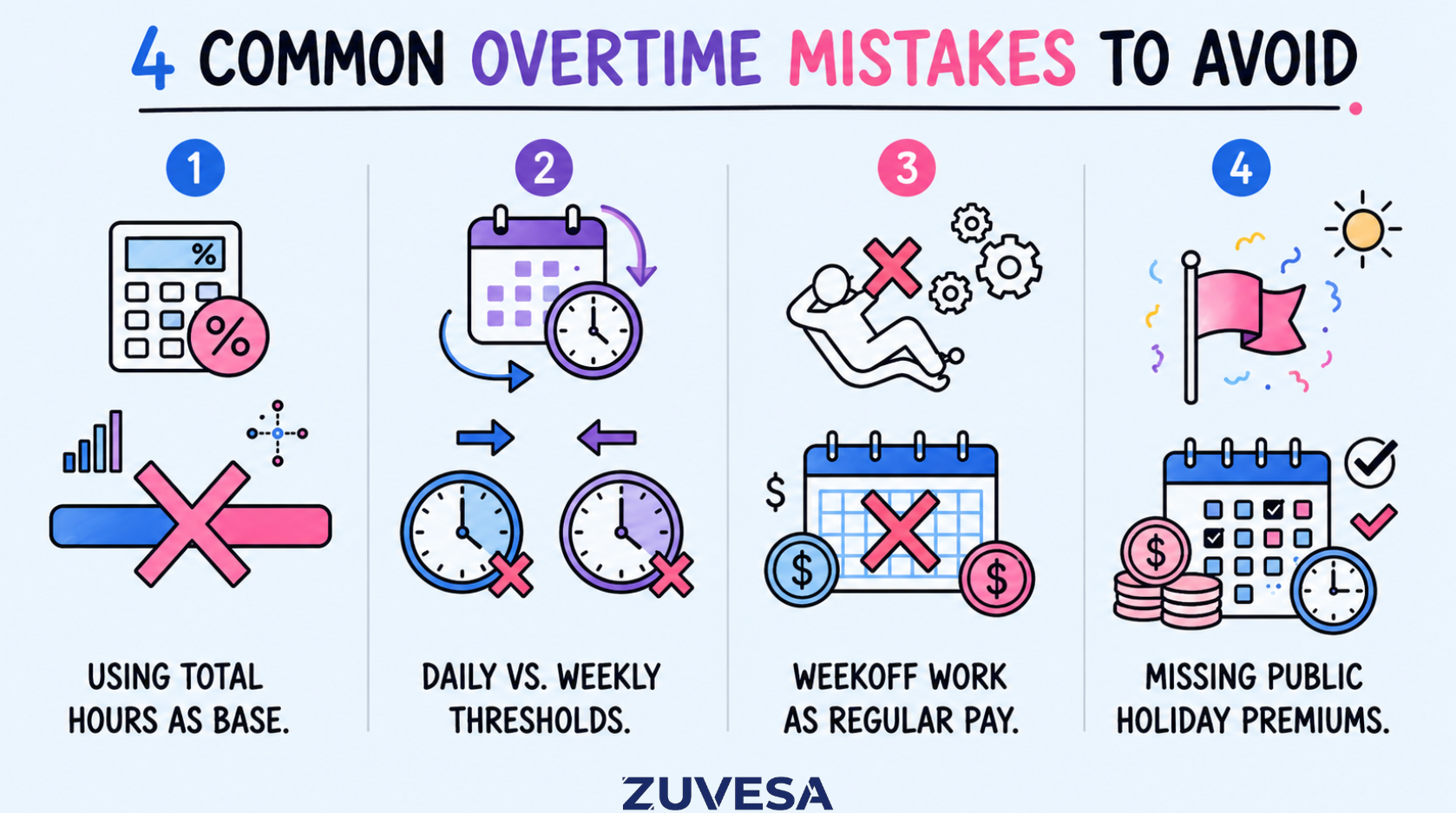
- Using total hours instead of regular hours as the base:
Overtime is meant to be a premium layered on top of standard pay—not on a number that already includes allowances, incentives, or bonuses. When everything is bundled together before the calculation, the system ends up compounding the wrong figure. Sometimes that means overpaying, sometimes underpaying—but either way, it’s inaccurate.
The correct sequence: Calculate regular pay first, define the true base rate, and only then apply the overtime multiplier.
- Applying a daily threshold when the contract says weekly (or vice versa):
In some regions and contracts, overtime kicks in when you work more than 8 hours in a day - even if you work fewer than 40 hours that week. In others, it only applies after 40 hours in a week, regardless of daily distribution.
On paper, the difference seems minor. In reality, it can completely change the final numbers for someone working irregular shifts. The problem is that many payroll systems force a one setting rule, while real teams often operate under mixed contract types, that's the real problem. The output may look clean, but it won’t be correct.
- Treating weekoff work as regular pay instead of overtime:
An employee comes to work on their weekoff voluntarily, the attendance is recorded, everything appears in order - and yet at month end, when payroll runs, those hours are treated like any other working day. The premium that should have been applied never enters the equation. But their contract speaks that weekoff work should be compensated by 1.5×, but nobody flagged it, just a silent miss. These are the kinds of errors that don’t trigger immediate complaints but slowly erode trust over time.
- Missing public holiday premiums entirely:
Public holidays create a similar blind spot. A shift worked on a national holiday can look identical to a regular weekday in most systems - same hours, same attendance logs, same structure. But the difference lies in the entitlement: that shift often carries a higher rate or special compensation.
If the system doesn’t actively recognize the holiday calendar, it processes everything as usual. From the outside, nothing looks wrong. But from the employee’s perspective, something important is missing, the premium the workers were entitled to are missing.
Why this keeps happening:
Here’s the uncomfortable truth: in most payroll systems, overtime isn’t designed as a core feature—it’s treated like a checkbox.
You switch it on or off. You enter a percentage. And the system assumes that’s enough.
Real overtime logic needs:
- A per-shift threshold (how many minutes before OT kicks in): Atleast, meaningful overtime logic needs to understand the shift itself. When does overtime actually begin - after 8 hours, 9 hours, or a custom threshold defined by the role? That cut-off isn’t universal, and treating it like it is leads to distorted calculations.
- A weekoff rule (does working on a day off count as OT automatically?): If someone works on their designated day off, is that automatically overtime? In many contracts, yes. But most systems don’t inherently recognize that gap - they just log it as another working day unless someone intervenes.
- The ability to apply those rules per contract or per team, not just globally: Different teams, roles, or contracts often come with different overtime rules. Yet a lot of payroll tools apply a single global setting across the board, forcing businesses to fit their people into rigid logic instead of the other way around.
When that level of detail is missing, the system doesn’t really handle overtime - it outsources the complexity to humans. Someone has to review edge cases, make judgment calls, and fix what the software couldn’t interpret. The problem is, judgment calls don’t stay isolated. They stack up.
What correct overtime handling looks like in practice:
Now let’s put numbers to it - because this is where small mistakes stop looking small.
Take a daily worker who clocks 20 days in a month. Their contract is clear: any work beyond 480 minutes (8 hours) in a shift qualifies as overtime, paid at a 50% premium.
On the surface, the month looks routine. But a few longer shifts here and there quietly change the equation:
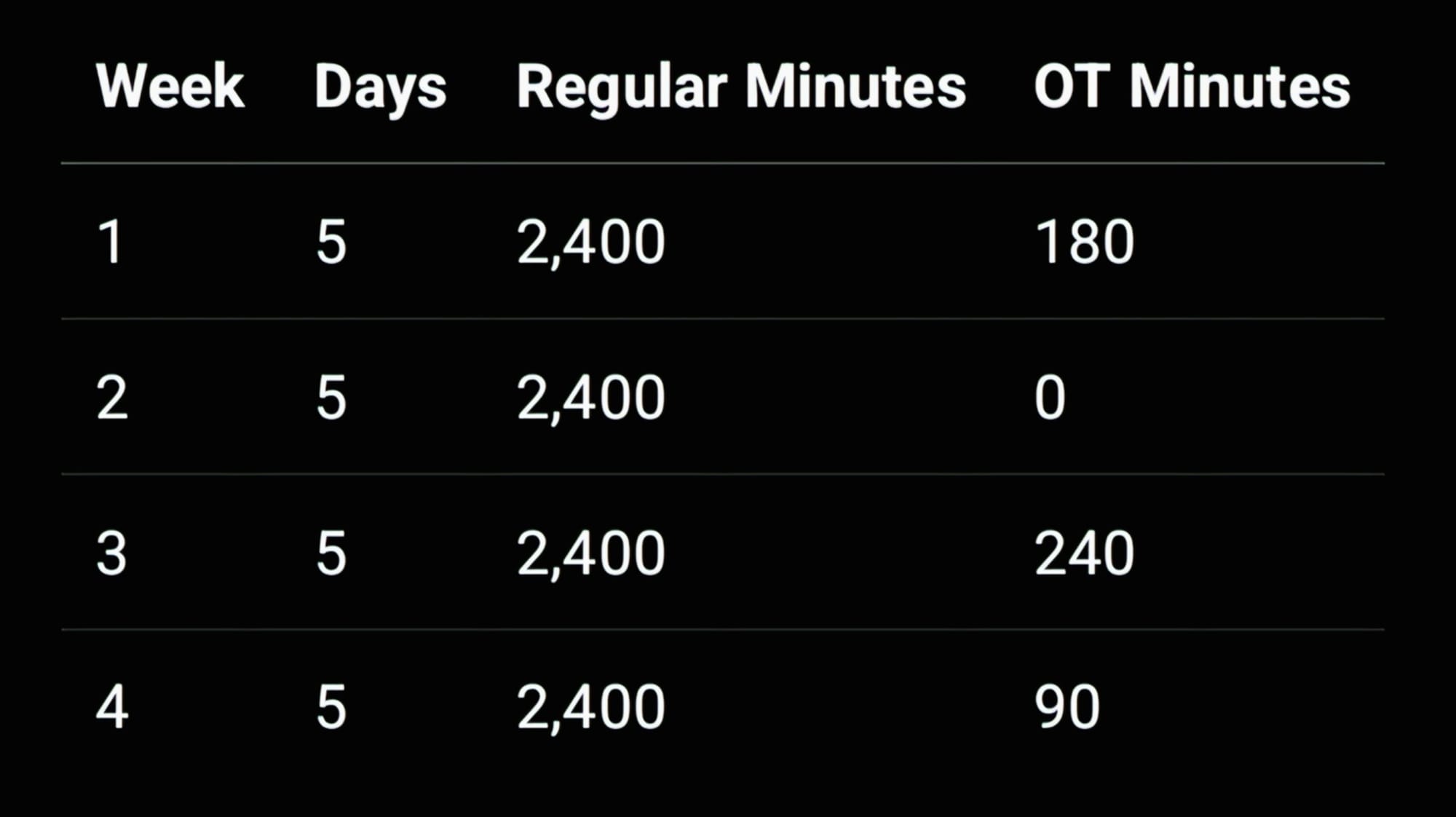
Total regular: 9,600 min = 160 hours
Total OT: 510 min = 8.5 hours
Now apply the correct logic. The worker earns ₹800 per day, which translates as:
- Regular pay: 160 × ₹100 = ₹16,000
- OT pay: 8.5 × ₹150 = ₹1,275
- Total: ₹17,275
Now imagine the system didn't have a threshold check and just paid 160+8.5=168.5 hours at ₹100 flat. That's ₹16,850.
The worker is short ₹425 this month. Over a team of 30, over 12 months - that's ₹153,000 in underpayments sitting in a spreadsheet no one audited.
No red flag. No visible error. Just ₹425 missing.
How Payzu handles this:
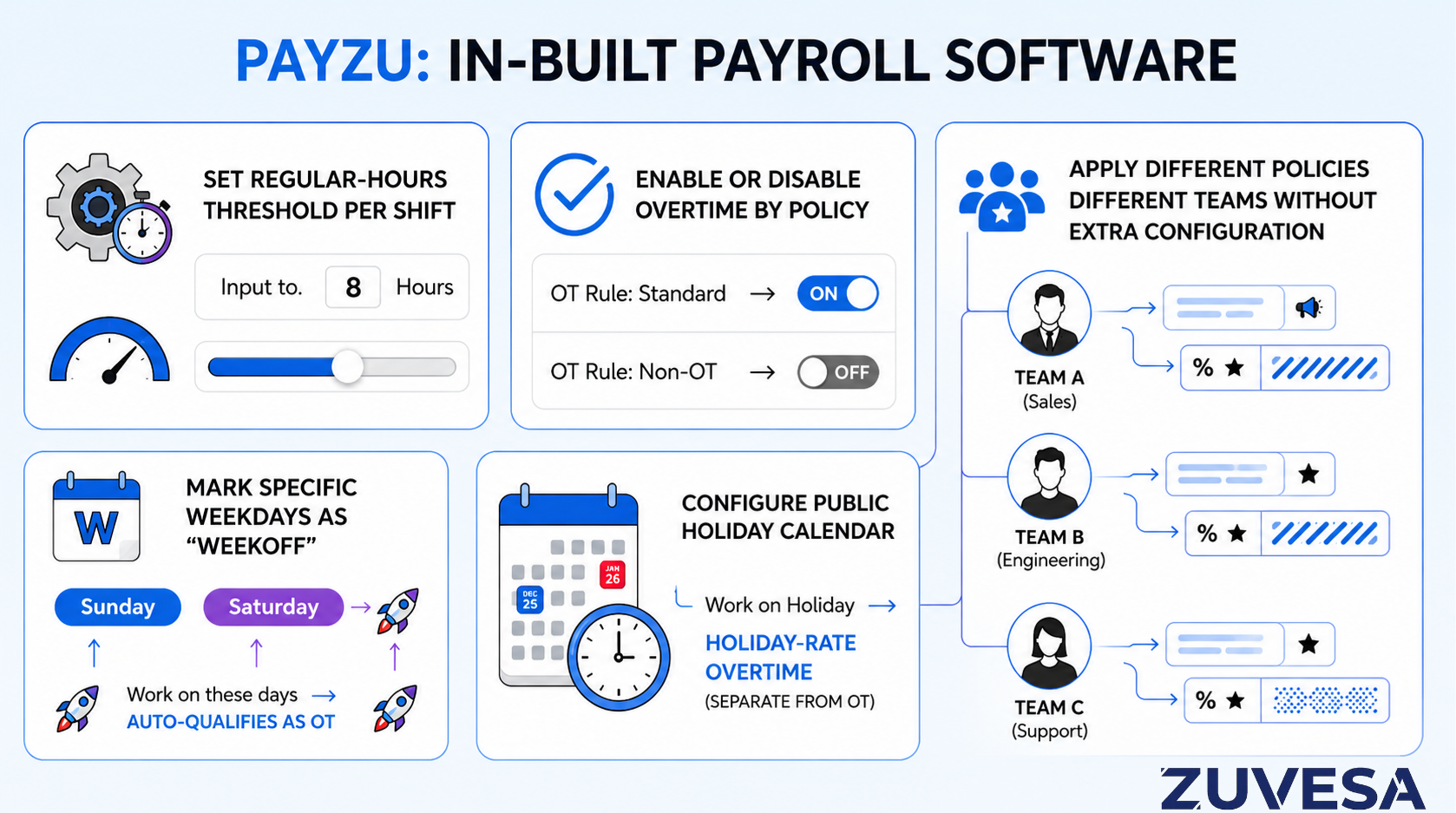
This is exactly where most payroll systems fall short - and where Payzu takes a fundamentally different approach.
Instead of treating overtime as a flat rule applied at the end, Payzu builds it into the core of how payroll is calculated - shift by shift, worker by worker:
- Set your regular-hours threshold per shift
- Enable or disable overtime by policy
- Mark specific weekdays as "weekoff" - work on those days auto-qualifies as OT
- Configure a public holiday calendar - any shift worked on a public holiday automatically qualifies for holiday-rate overtime, separate from regular weekoff rules, and the system will not charge the worker's leave balance for those days
- Apply different policies to different teams without any extra configuration
What makes this truly reliable is visibility. Every payslip breaks down exactly what happened: regular hours, overtime hours, the rates applied, and the final payout. It's quite easy and effective for Shift Management There’s no hidden logic buried in a spreadsheet formula, no black box you have to trust blindly.
See how Payzu handles overtime for your team at Zuvesa.
The tricky thing about payroll errors is that they almost never announce themselves. They don’t crash systems or throw obvious alerts. They slip in quietly - through small miscalculations, missed rules, or assumptions that go unchecked. And overtime is where this happens most often.
See it all together.
Book a 20-minute live demo and we'll walk you through every module that fits your business.