
Payroll for Shift Workers: Common Mistakes & Smart Solutions
Learn how to manage payroll for shift workers without errors. Handle overtime, night shifts, and proration accurately with modern payroll tools.
This is one of those quiet, recurring scenes that plays out behind the curtains of thousands of businesses - rarely talked about, but deeply felt.
It’s the last day of the month. A warehouse manager logs into the payroll system, hoping for a clean, reliable close. But the reality is messier. Half the workforce runs on night shifts. Some are paid per piece, not per hour. A handful stepped in for overtime over the weekend when operations hit a snag - and those hours? Logged manually, somewhere between urgency and approximation. One employee took a couple of days off mid-cycle.
The software does what it’s supposed to do: it generates numbers. Neat, precise, final-looking numbers. So Managers does what they have learnt to do everywhere. They open a spreadsheet. They retrace steps. They cross-check entries. Line by line. For hours.
Sounds familiar?
The real problem isn't effort - it's that the tools weren't built for this.
Most payroll systems were built on a comforting, but outdated idea: that work is predictable. Fixed hours. Fixed schedules. Fixed salaries. The same rhythm, week after week.
That model might describe a slice of the workforce - but not the reality most businesses operate in today.
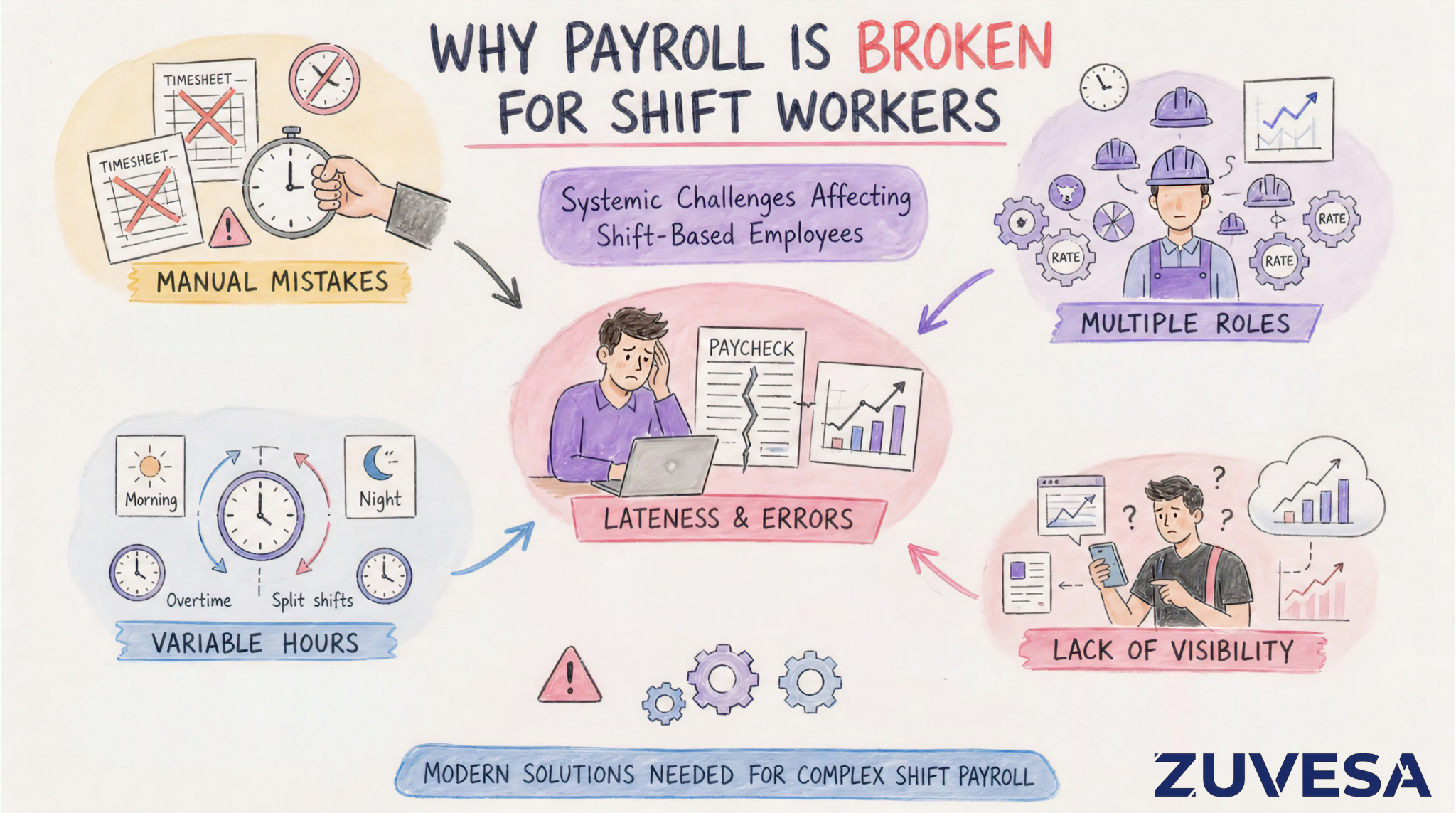
Step into the day-to-day of retail floors, warehouse operations, factory lines, hospitality teams, or field staff, and the pattern looks very different. Work bends. It shifts. It refuses to stay inside clean boxes.
- There are night shifts that quietly carry a higher cost - sometimes by law, always by effort.
- There are roles where pay isn’t tied to time at all, but to output - what gets done, not how long it took.
- Schedules stretch and contract, with the same employee working six days one week and four the next.
- Overtime isn’t a single rule - it fragments across shift types, days, and contract terms.
And this is where the gap begins. Because when software is built for simplicity, it struggles with reality’s complexity. It produces numbers - but not always understanding. So someone, somewhere, steps in to bridge that gap.
Usually with a spreadsheet. Usually under time pressure. And that’s where the real cost shows up - not loudly, but in small, compounding inaccuracy.
The things that quietly go wrong
The real problem with payroll errors is that they rarely announce themselves. They slip through quietly - embedded in calculations that look right at first glance.
Take night shifts. If the system doesn’t recognize that someone worked from 10pm to 6am, it treats those hours like any other. On paper, everything balances. In reality, the employee just lost out on a 20–30% differential - and no one flags it.
Overtime calculated on the wrong base. It’s not just about extra hours, but how those hours are calculated. Get the base wrong - apply it on an already inflated rate instead of the regular one - and the numbers drift. Not dramatically, not enough to trigger alarms, but consistently. Month after month.
Proration guesswork. Someone joins on the 12th - simple question, complicated answers. Do you divide by 30? By the actual number of days in that month? By working days only? The “correct” answer depends entirely on company policy. But most systems don’t ask. They decide.
Bonuses taxed at the wrong rate. Is it taxed before payroll or after? Should it be grouped with salary or handled separately? The software makes a call, one way or the other. Over time, that choice quietly shifts real money.
None of these are dramatic failures. They’re small misalignments between how work actually happens and how systems assume it does. And that’s exactly why they’re so easy to miss and so expensive to ignore.
What does a properly built payroll engine actually do?
What most systems get wrong isn’t just the math - it’s the sequence. Because in payroll, when something is applied matters just as much as what is applied.
- Start with base pay - adjusted for attendance and proration.
- Add taxable allowances and bonuses (these affect the statutory deduction base).
- Subtract pre-tax deductions like approved damage costs.
- Calculate statutory deductions on the correct taxable figure.
- Add non-taxable post-pay components like travel reimbursements.
- Subtract post-tax deductions like loan repayments.
- Arrive at net pay.
Because payroll shouldn’t feel like a black box. It should read like a ledger - transparent, traceable, and easy to trust.
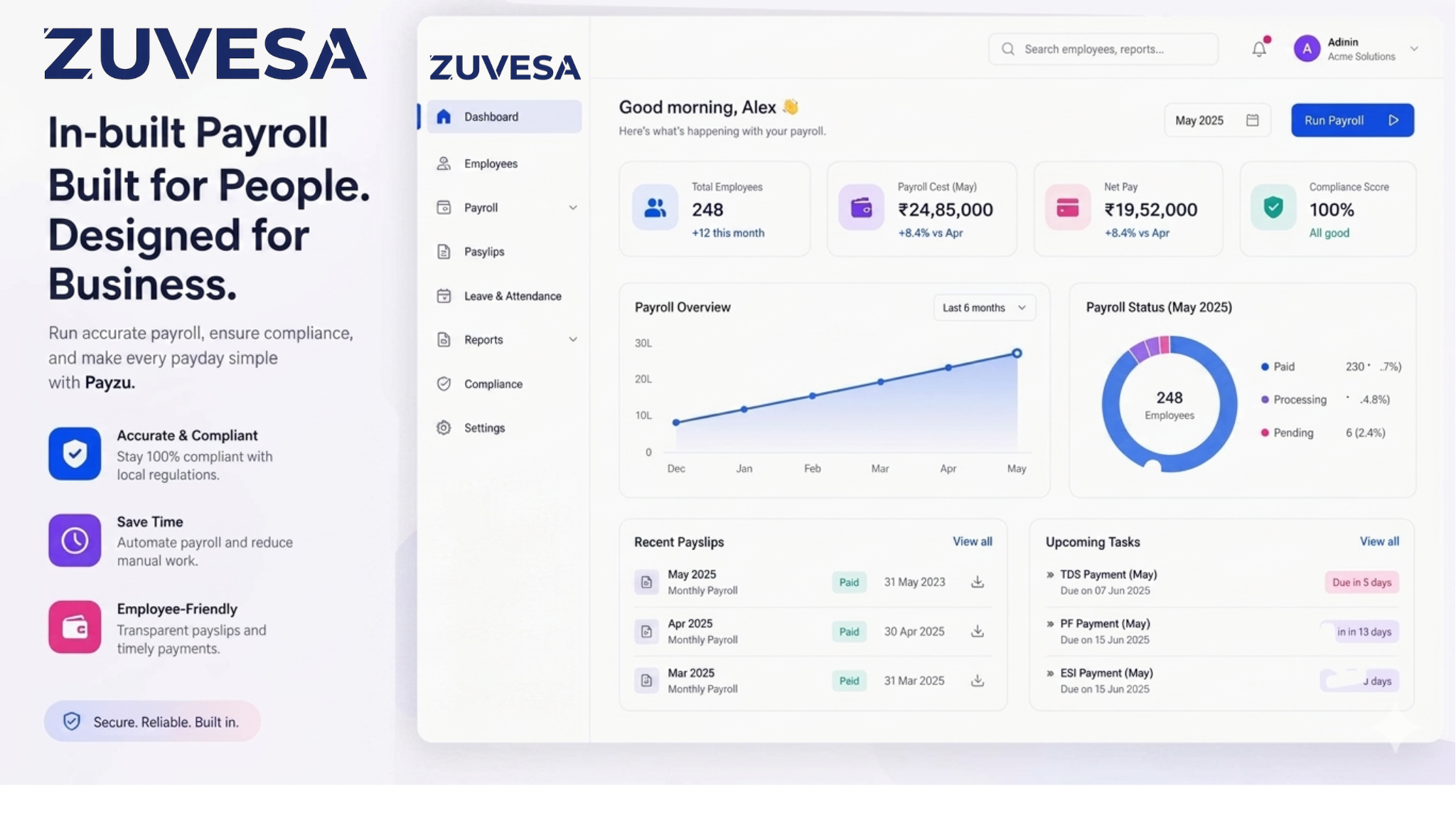
That's what we built into Payzu, the payroll module inside Zuvesa.
Why we built it this way:
We built Zuvesa for businesses that run on a pattern that don’t run on neat schedules or predictable hours. Retail chains closing late. Warehouses running through the night. Delivery operations that spike and dip without warning. Manufacturing units where output matters more than clock-ins.Too many workarounds. Too many spreadsheets. Too many month-end headaches.
Payzu handles:
Payzu isn’t trying to simplify payroll by ignoring complexity. It handles it—quietly, in the background, where it belongs.
- Multiple pay types on the same team (hourly, daily, fixed monthly, piece-rate)
- Shift differential rules configurable without code
- Night, weekend, and custom schedule recognition
- Proration by calendar days or working days - your choice
- Statutory deductions that respect the correct taxable base
- Policy-based leave types with individual balance tracking and conflict detection against the shift schedule
- Public holiday calendar - any shift worked on a public holiday is automatically flagged as holiday overtime, not charged against the worker's leave balance
It’s not about adding more controls. It’s about removing the need to double-check everything. Because when payroll actually understands how your team works, month-end stops feeling like damage control - and starts feeling routine.
If your team works shifts, try Payzu Payroll software for free. Setup takes less time than your next manual payroll reconciliation.
Running a team on rotating shifts? We'd love to hear about your current payroll process. Drop us a note at [email protected].
See it all together.
Book a 20-minute live demo and we'll walk you through every module that fits your business.