
How Hierarchical Payroll Policies Simplify Complex Teams.
Manual payroll overrides seem harmless — until they become your entire payroll process. Here's a better way to manage exceptions at scale.Discover why manual payroll overrides create errors, operational risk, and compliance issues — and how hierarchical payroll policies solve the problem.
What most payroll software quietly assumes is that every employee in your company fits into the same neat little box. Same salary structure. Same deductions. Same attendance logic. Same compliance setup. You configure the system once, click “Run Payroll” every month, and everything is supposed to work perfectly.
And to be fair, that model works for some businesses. If you’re running a small SaaS company with a handful of employees on fixed salaries and identical PF rules, payroll is relatively straightforward.
But the moment your workforce becomes even slightly more complex, that simplicity starts to break down. A retail chain with multiple stores doesn’t operate like a software startup. Neither does a manufacturing unit, a logistics company, or a business that depends on shift workers and mixed employment models. Suddenly, you’re dealing with full-time staff, part-time workers, temporary hires, contractors, and piece-rate employees — all under the same roof, but following completely different payroll rules.
And that’s where traditional payroll systems begin to feel less like a solution and more like a limitation.
What actually varies across a real workforce:
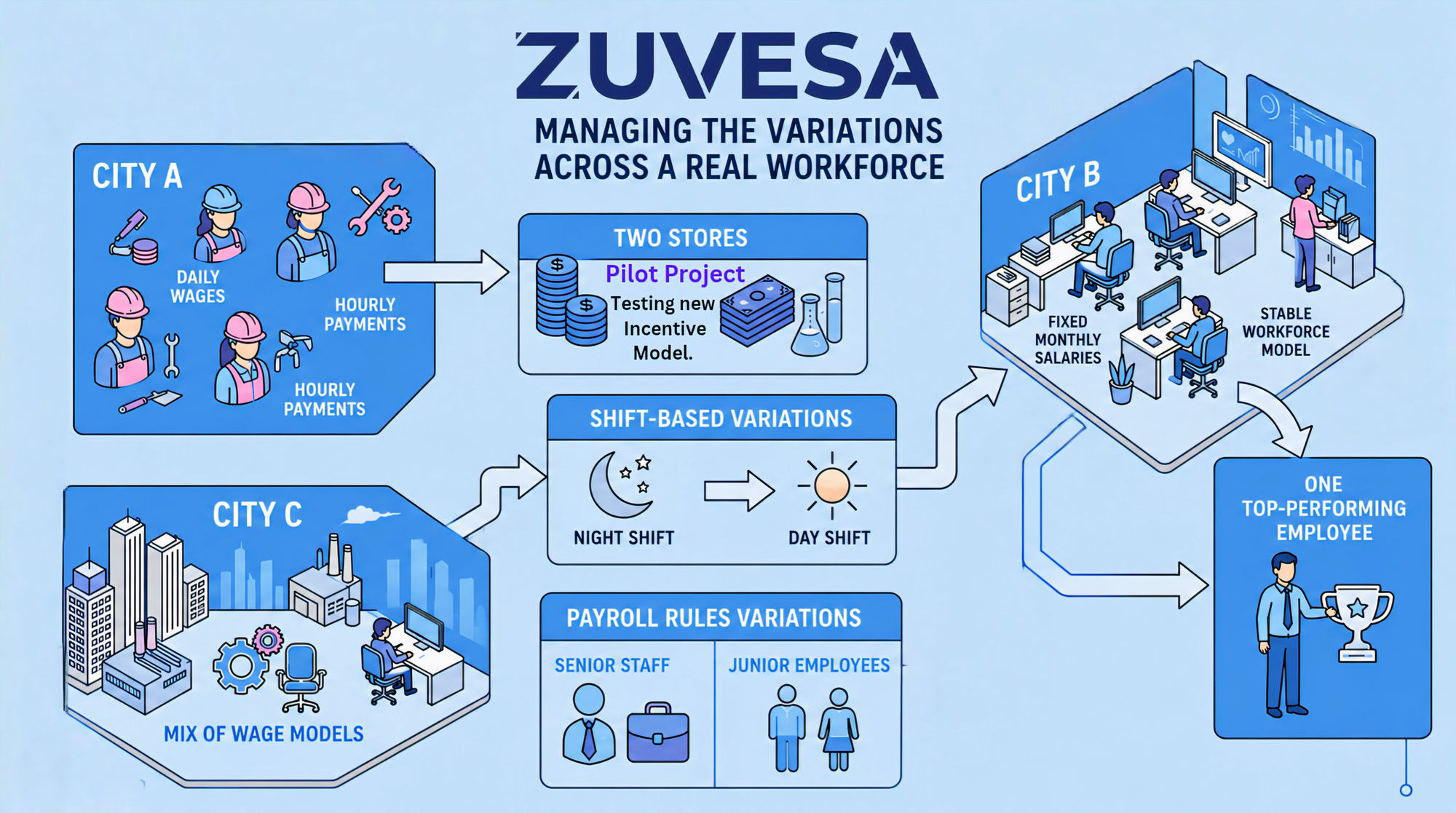
Now imagine running a chain of stores spread across three different cities. On your chart, everyone might simply be labeled as “store associates.” But anyone who actually manages payroll knows the reality is far more complicated than that.
- In City A, employees may be paid on daily wages. In City B, the entire workforce could be on fixed monthly salaries. The City C might operate with a mix of both models at the same time.
- Then there are shift-based variations. Night shift employees receive additional allowances. Day shift employees don’t.
- Senior staff qualify for overtime under one set of rules, while junior employees follow an entirely different threshold.
- Maybe two of your stores in City A are testing a new incentive model. Maybe those locations also have different statutory deduction rules because of how the pilot is structured.
- Maybe one top-performing employee in City B, negotiated a completely custom bonus agreement that applies only to them.
None of these situations are unusual. They’re the kind of real-world payroll scenarios growing businesses deal with constantly. The problem is that most payroll systems weren’t designed for this level of flexibility. They expect consistency across the organization - one policy, one structure, one logic applied to everyone. So businesses end up compensating manually. Every months.
The override problem:
Manual overrides can patch payroll for one month. What they don’t do is create a system that remains reliable over time. Because payroll complexity doesn’t stay still. Next month, a new employee joins under a slightly different compensation structure. A store changes shifts. An incentive policy gets updated midway through the cycle. Someone forgets to copy a formula in the spreadsheet that has quietly become part of the payroll workflow.
And suddenly, the “temporary adjustment” from three months ago turns into a payroll error nobody notices until salaries have already been processed.
Every manual override moves critical knowledge outside the software itself — into spreadsheets, sticky notes, internal chats, or the memory of the one HR manager who knows how everything actually works. At first, it feels manageable. Then the process becomes dependent on specific people remembering specific details at specific times.
The more manual exceptions live outside the system, the more fragile your payroll process becomes. One overlooked note in a spreadsheet and someone gets paid wrong. Someone gets underpaid, overpaid, or paid incorrectly altogether.
By then, the issue is no longer just operational. It becomes a trust problem.
A better mental model: policy inheritance
The best payroll systems don’t treat policies as rigid, one-size-fits-all settings. They treat them more like organizational permissions — layered, flexible, and capable of adapting to how a business actually operates.
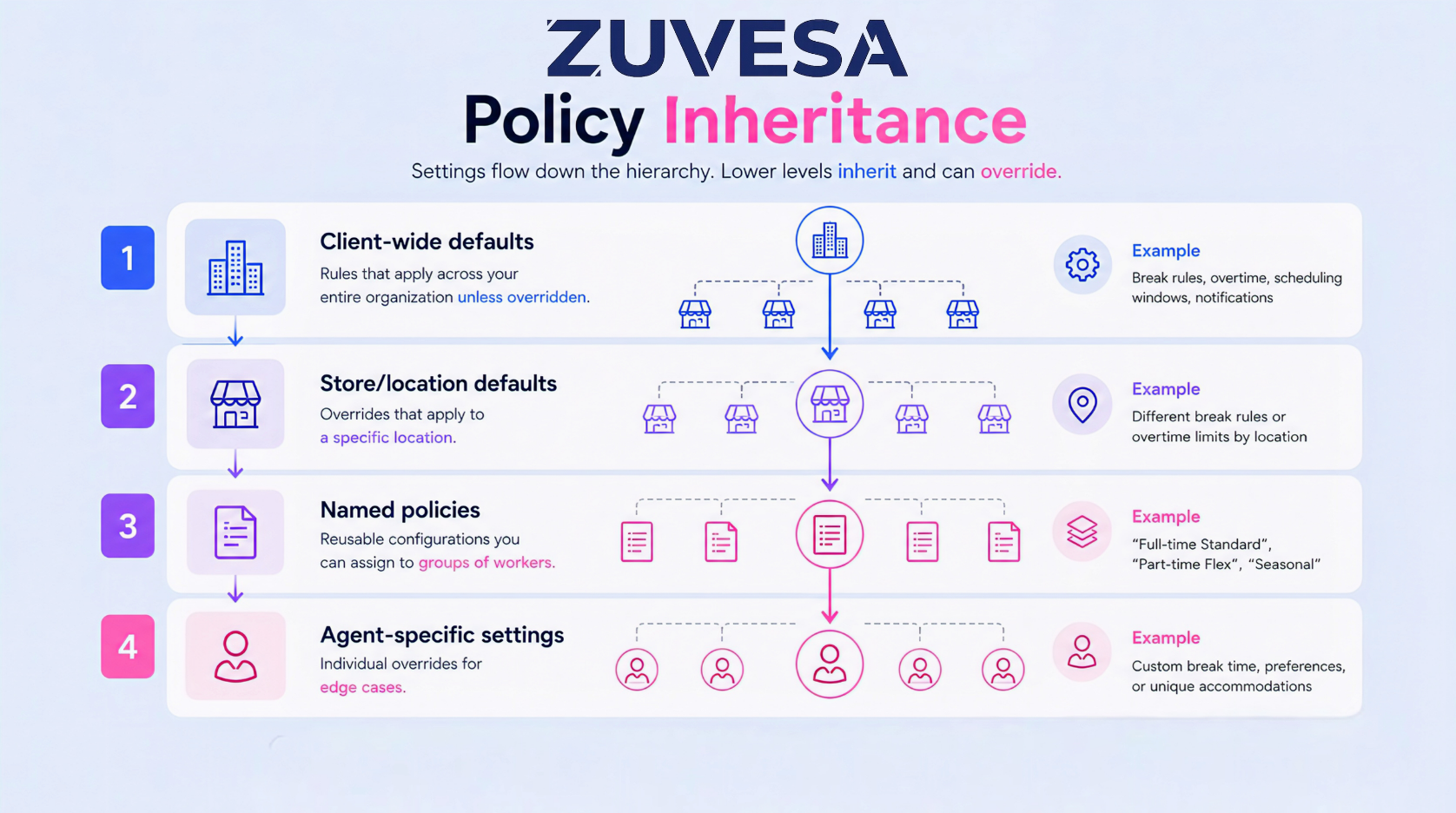
At the top level, you define broad company-wide rules.But as you move deeper into the organization, more specific rules can selectively override those defaults where needed.
Likewise:
- Client-wide defaults - rules that apply across your entire organization unless overridden.
- Store/location defaults - overrides that apply to a specific location.
- Named policies - reusable configurations you can assign to groups of workers.
- Agent-specific settings - individual overrides for edge cases.
When payroll is processed for an individual employee, the system shouldn’t rely on HR teams remembering special cases manually. It should be able to determine the correct rules automatically. The way modern payroll architecture handles this is through hierarchical rule resolution.
This means: - Your standard overtime policy applies everywhere by default.
- Except Store 7, which has its own overtime threshold for night shifts.
- Except Meera, whose custom agreement overrides everything else.
No side spreadsheets tracking exceptions. No sticky notes on someone’s desk. No Slack messages saying, “Don’t forget to adjust this employee’s overtime before payroll closes.” Everything lives inside the system itself.
How this plays out in practice:
Scenario: You run 8 stores. 7 stores run the standard policy — fixed monthly salary, 12% PF, standard proration. One store (your pilot location) is testing hourly-rate workers with a different OT rule and an additional night differential. Without hierarchy: You set up one global policy, then manually adjust 3–4 fields for every payroll run at the pilot store. You do this 12 times a year. You train two different HR people on it. One of them forgets. With hierarchy: You create a separate store-level policy for the pilot location. It inherits everything from the global policy except the fields it overrides. When payroll runs, each store gets the right numbers automatically.
The employees at the pilot location don’t require individual payroll customization at all. Nobody has to configure overtime rules employee by employee. Nobody needs to manually attach special allowances every payroll cycle. They simply inherit the correct setup from their store-level policy automatically.
What about true one-offs?
Of course, no matter how well-designed your policy structure is, there will always be a few employees who don’t fit neatly into any standard category. And that’s normal.
A long-tenured employee may have a legacy allowance negotiated years ago. A specialized technician might work on a completely different daily rate structure than the rest of the team. A senior manager could have a custom bonus agreement tied to performance targets that apply to nobody else in the company.
These should be supported too — individual settings that override any policy, without requiring you to create a whole new policy just for one person.
That final layer is what makes the entire hierarchy practical. It exists to handle the genuine edge cases — the rare situations where an employee truly needs a custom rule that shouldn’t apply to anyone else. But importantly, those exceptions stay contained at the individual level instead of leaking into the rest of the payroll structure.
How Payzu approaches this:
That’s exactly how Payzu approaches payroll architecture.
When a payroll run begins for an employee, the system doesn’t rely on a single flat configuration or a chain of manual overrides. Instead, the payroll engine resolves that employee’s effective settings through a structured five-level waterfall.
Likewise:
- Agent-specific override (if set)
- Assigned named policy (if any)
- Store-level defaults
- Client-wide defaults
- Error if nothing is found
Every pay type, overtime rule, allowance configuration, deduction structure, and statutory setup participates in the same layered inheritance model. Which means businesses can manage dozens of compensation structures across locations, departments, shifts, and employee categories without maintaining a growing spreadsheet of exceptions in the background.
Leave management follows the same principle. Instead of assigning leave rules employee by employee, organizations define leave policies centrally — annual leave, sick leave, personal days, compensatory offs, or any other category relevant to the business. Employees inherit those entitlements automatically based on the policy structure they belong to. And when exceptions genuinely exist, the system supports those too.
Public holidays are handled centrally as well. Instead of each manager manually remembering holiday calendars every payroll cycle, holidays are maintained once at the organization level and applied automatically across the system.
So if an employee submits leave that overlaps with a public holiday, the platform surfaces the conflict immediately. That date is treated correctly as a holiday or overtime day instead of consuming the employee’s leave balance accidentally.
Set up your team's payroll policies in Payzu.
If your payroll process still depends on spreadsheets full of manual exceptions living outside the actual system, it’s probably worth taking a closer look at how much operational risk that creates over time.
Happy to show you how the hierarchy approach works in practice inside Zuvesa — reach out at [email protected].
See it all together.
Book a 20-minute live demo and we'll walk you through every module that fits your business.